

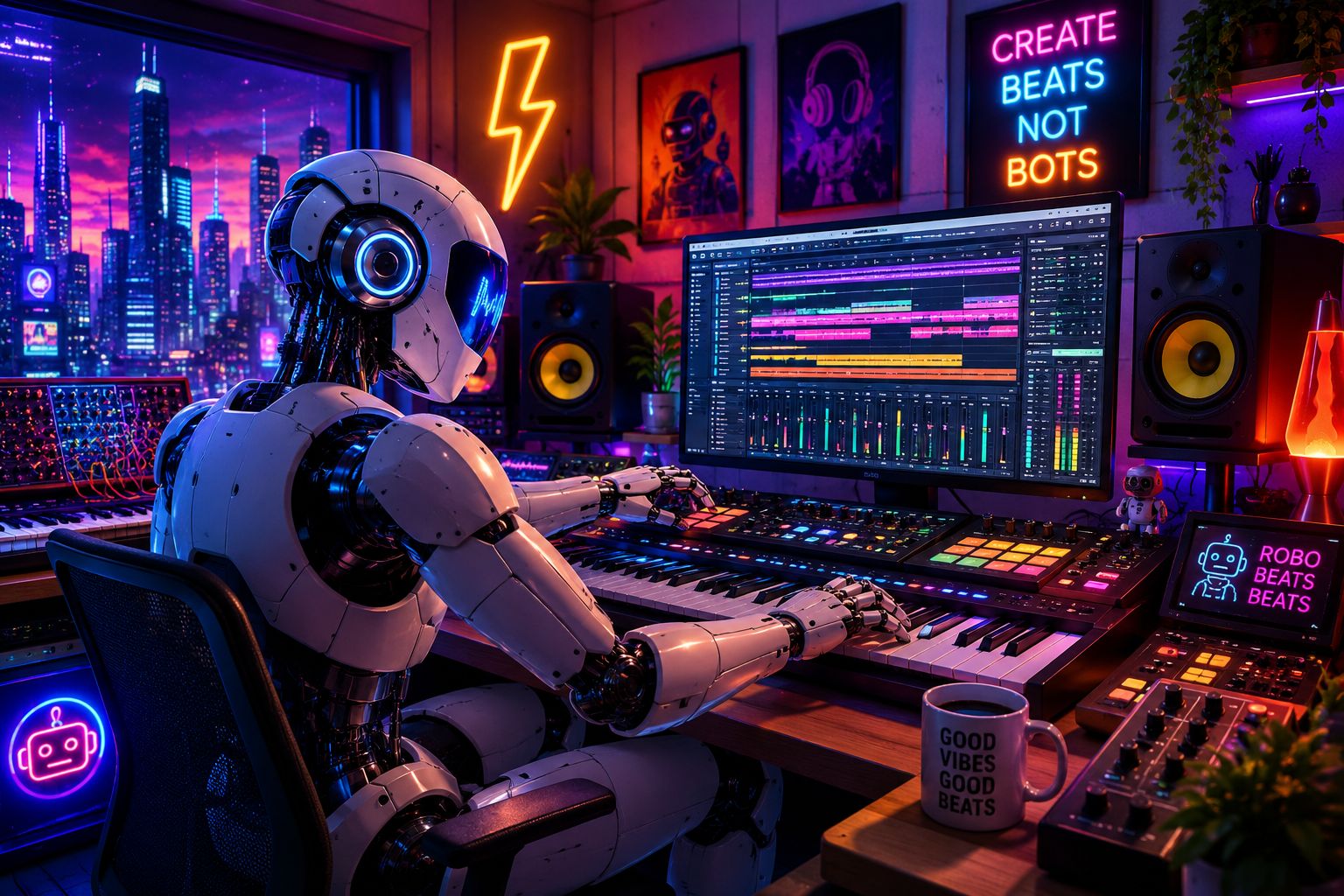
It’s time to address the fake elephant in the room; AI music.
With AI music popping up more and more regularly across streaming services, algorithms, social media, playlists, charts, and already taking over the world of background music etc, is AI music about to ruin music forever?
In the Autumn/Fall of last year AI music accounted for around a third of our submissions. It’s now nearing the 60% mark in just a few short months, and it’s only going to get worse. Suno, the world’s leading AI music generator, is pumping out a whopping 7 million fully AI music tracks a day. That’s the equivalent of Spotify’s entire back catalogue every two weeks!
This isn’t just a flash in the pan, this is a real problem.
Do you remember the last time you had to search, and I mean really search, for the truth to a story a friend told you which sounded too unbelievable to be real, or to backup an outrageous click-bait headline you saw on social media? Whether that search revealed them to be true or not is irrelevant here, it probably took you forever to sort through the cesspit of fake news, opinions, and content that’s online nowadays to eventually find it. If you answered yes to that question and you love music, I give you fair warning, this article’s going to scare you.
Thought music was the one place you could escape from today’s daily fight between what’s real and fake? Think again. It won’t be long until even the most ardent music listeners get burned out distinguishing between real and fake music, finding the good real music, and even lose the joy of music entirely. That’s the challenge that faces us with AI music. The switch from CDs to streaming culture was bad enough, not just for artists’ pockets, but for quality control purposes too. The quality of submissions to websites such as ours, and radio stations etc, took a nose dive as suddenly anyone and everyone could release music and call themselves an artist. While that change did allow for some really good artists to suddenly gain some traction without a label’s help and not slip under the radar, they were in the minority and the floodgates of ‘mediocre-at-best’ (and that’s putting it kindly!) music cascaded opened. Now, with AI music barging through the door, it’s about to get a whole load worse.
There’s no denying AI is a useful tool, even in the process of making music, but if a whole song is 100% AI (or the majority of it is), it’s no longer being used as a tool to enhance your music, it’s replaced you entirely and made a mockery of music in the process. The beauty of music is it bypasses any protective barriers we’ve put up and connects directly to our soul. It helps us feel seen in a way that people can’t. It helps us say words we can’t say. It helps us feel emotions we need to feel. Especially with Christian music. AI music can’t do any of that. Or, as my close friend Elena puts it, “There’s no actual person behind the “story” the song’s telling, it’s just words. It lacks connection. It’s…just…fake.” Worse even, “it takes away from the people who actually spend their time, heart, and soul writing their music.” Not to mention all of the music producers and graphic designers etc who are suddenly replaced by intentionless sloppy ‘prompted’ ‘art’ and find themselves struggling for work. Why pay for someone to design your cover art when you can just create it yourself with a few prompts in seconds for free? Why spend years crafting music when artificial intelligence could create it in seconds?
Put simply, it’s because real music matters. Why are so many people in the CHH community hailing indie tribe‘s recent album Who Do You Say I Am? as one of the best CHH albums in decades, if not ever? It’s because they poured every aspect of themselves into it, and worked really hard together to craft it so the music, lyrics and heart all worked in tandem to create a beautiful soulful masterpiece. It’s because it contains real emotion and raw desperation listeners can connect and relate to. It’s because it’s authentic and real. Not to mention how it’s helped myself and many others in our relationship and walks with God! AI music can only dream of ever matching that…(or even of dreaming at all, that would require a consciousness wouldn’t it?!)
Scared yet? We’re only just getting started!
AI music not only threatens authenticity, it threatens our enjoyment of music. Imagine you’re at the top of a long helterskelter slide. All your past times on these slides were fun so this time should be no different, right? But now imagine that as you’re going down you’re constantly checking the next piece of slide is actually real and there, or whether its bolts have become loose or are just missing entirely and you might be about to fall to the section below. Even if the whole slide is in fact intact, was the slide fun this time? Or was it anxiety inducing?
Music should be fun or a comfort, not a chore. We should be able to select the music that fits our current scenario or mood easily, and not spend ages discerning whether it’s real or not.
Right now it’s easy for the ardent listener to discern whether something is completely AI music or not, all the common markers, or ‘artefacts’, are there (“too perfect” fake synthetic vocals, slurred words, no emotion, strict song structure, and instruments & a mix which don’t sound true or crisp etc), but the majority of people aren’t aware they’re listening to AI music at all. That’s scary! And that’s before it gets ‘better,’ and trust me it’s getting ‘better’ quickly. It already has over the last 8 months, and there’s already the odd pretty convincing sounding tracks here or there. In a year’s time it’s going to be a lot more convincing, and harder to distinguish. The trained ear will still be able to pick it up, but do we really want to be listening to music trying to discern whether it’s real or not? Or putting up with friends sharing a “great song” with us only for it to be AI and causing us to throw our phones across the room…or at them(?!)…in frustration? We want to listen to music because we want to listen to music, not to exercise our brains in that way! I’m already struggling to hold my tongue when I see friends or artists share posts or stories on socials with AI music.
There will be many of you reading this who’ve suddenly realised something you listened to recently was AI music and I bet you’re feeling duped right now aren’t you? I imagine it would be a similar type feeling to if you suddenly found out the sermons you were hearing on sundays at church were written by chatgpt wouldn’t you? (which is a scary thought, even scarier to think that’s probably happening too!). We shouldn’t have to deal with this, we should be able to trust what we’re listening to. Especially when it comes to Christian music!
The trust issue doesn’t stop there either. AI music has to learn from music that already exists which is a copyright infringement headache (if not migraine!), and there are already major lawsuits against generative AI music platforms such as Suno currently being worked through. The UK government (where I’m personally from) are currently trying to navigate these muddy waters to adapt their copyright laws in a fair way (You can read more here). As governments work these things out, Sony Music Group is one record label who are taking things into their own hands and proactively working to exclude their discography from the content AI bots can learn from.
And we’re not done yet! Many fake new songs from popular artists are starting to crop up on YouTube, with fake new NF songs being the ones I’ve noticed the most of so far. And you’ve guessed it, many listeners are being duped into thinking NF’s dropped new music, despite his vocal tone being vastly different and the music lacking NF’s usual attention to detail. The thought that artists, the real artists, are being misrepresented should send shockwaves through your whole body. Artists will also soon have to start publicly declaring that “such and such a song or album wasn’t mine”, and will be yet another thing on top of today’s mandatory ‘content game’ that’ll further sap real artists’ energy which will in turn further stifle their creativity, or even drive to continue making music. The public outcry from artists soon will be immense!
There are also instances of AI artists releasing music on Spotify under the name of artists who already exist. Remember the CHH artist Json? He hasn’t released music since his Foreign Volume 1. EP in 2016. Yet, according to spotify, he’s released 25 albums/EPs and almost 100 other singles…all over the past year! I’ve had to unfollow his Spotify profile and rely on seeing if the real Json releases new music from his social media (which is a long shot with the state of socials’ organic reach for authentic people/artists – I had to check I was even still following him!). Pop artist Terrian is another to fall victim of this, resulting in her posting this video to her socials – thankfully, the songs have since been taken down, but real artists shouldn’t have to go through this. I also no longer fully trust my Spotify release radar as a result, and I’ve seen other Christian music sites listing the AI Json’s releases under their new releases by mistake. I don’t blame them, there’s too much music dropping nowadays to keep up with, but it’ll help erode trust in music websites too.
Piggybacking on all of that mistrust is something much more serious. Fraud. AI is also stealing people’s songs and royalties. Yep, that’s actually happening!!
OK, so AI itself isn’t stealing people’s songs but people are using it to do so. The story of folk musician Murphy Campbell went viral in recent months after AI cloned her voice from her YouTube videos, made and uploaded new tracks with her voice, and then filed copyright claims via Vydia against the same videos AI learned from…and, as YouTube initially processes copyright claims automatically, she lost the royalties…from her own music. Thankfully since her story went viral, Vydia wiped out those claims and banned the claimant, but that’s insane! (You can watch her share more here).
Similarly, Ninth Key, the collaboration project set up by secular artists Ekoh and Lo.Spirit, are preparing to release their debut single “if I wasn’t me” tomorrow and someone stole the preview of the chorus they’d posted to socials, used it to prompt a song through Suno etc, and uploaded it to Spotify before the original was due to be out. It then started to attach itself to their actual TikTok account. All of which means people can claim off the back of all the marketing and effort the artists are putting in to their own music. Say whaaaat?!! You can watch Ekoh sharing about this here (warning: some foul language).
The moral of those two stories? Artists, protect your work! (And I wish you the best of luck with balancing posting less previews of new songs before they release while simultaneously promoting your upcoming release enough to be noticed among today’s tidal wave of content!)
I haven’t even mentioned Solomon Ray yet, a completely AI ‘artist’, topping the iTunes Christian & gospel charts at the end of last year, but do I even need to waste my time convincing you that’s ludicrous? I think not! (Dwayne “The Rock” Johnson, one of the world’s most famous and influential people, even used one of his songs on a recent instagram post.)
So what can be done about it?
I wish it was as simple as “let’s just all agree to cancel it once and for all,” but we all know that’s hoping for too much. Whether we like it or not, it’s here to stay. So what can be done about AI Music?
First, we need to start labelling it. In the same way as songs containing Explicit lyrics require an Explicit lyrics warning on the cover art, AI music needs a clear distinguishable marker of its own. That way even just the casual listener can quickly identify whether something’s real or not. (Maybe a square in the bottom left corner with ‘AI’ in it?)
Secondly, streaming platforms need to allow users to opt out of hearing any AI music.
Deezer, Apple Music and YouTube have been the first to do something about it. Deezer have implemented an automatic AI music detection tool at upload, and any tracks flagged by it are excluded from its algorithms and not added to editorial playlists. They’re also not stopping there, and are working to eliminate fake bot streams and have demonetised 85% of AI music so far. Apple Music has recently added AI music transparency tags, requiring record labels to flag where AI has been used across four key areas – Artwork, Track, Composition, and Music Video. YouTube have added a “Altered or synthetic content” tag but you have to go digging to the end of the video description to find it, and it’s not always there.
That’s a good start, especially from Deezer, but other streaming services need to catch up, and much more still needs to be done.
Thirdly, copyright laws need to catch up, and quick. With Suno pumping out over 7 million tracks per day, and the vast majority finding their way on to streaming platforms, music lawyers face a race against time (and probably sanity!) to catch up!
Got any ideas of what else could be done? Please comment with them below this post. Maybe we can make a difference together?
What are Spotify doing? I hear you ask…Well, they’re doing the antithesis of fighting back. They’re seemingly encouraging it. While they have just introduced a new “Verified by Spotify” checkmark on verified artists’ pages to seemingly help distinguish the difference between real and AI artists, they’ve just announced a partnership with Universal Music Group today where Spotify premium users will soon be able to remix UMG’s artists’ songs on Spotify’s platform using generative AI music tools. Add on to that that you have to have at least 10,000 monthly active listeners for three consecutive months and over 1,000 followers, among other criteria, to qualify for the “Verified by Spotify” checkmark (making it even harder for genuine small hard working real artists to get noticed), and it’s safe to say Spotify aren’t really helping!
Where we stand
I try my best to operate JesusWired with as soft boundaries as I possibly can, with few hard and fast rules in place, relying on my Holy Spirit filled gut to know where to draw the line on different issues. With AI music that’s different. It’s a solid no; we do not support AI music and we will never post any. Ever. They will be deleted instantly. So to all those people submitting it for coverage on our site, don’t waste your time. Think you can dress it up with a professional press release and slip it under the radar that way? Think again! I learned long ago, since the switch to streaming services, to listen to the music first, and only read the email afterwards if the music’s good enough to post. You won’t fool us!
Final Thoughts
Recently I’ve been slaving away behind the scenes sorting out some inherited issues with JesusWired and gearing up for our next era, and getting excited about implementing some cool new ideas, only for that spark to be extinguished by sorting through recent submissions and hearing nothing but AI slop, or just general rubbish (I recently went through over 50 recent submissions to our new releases list, I only added 4!). Between that, new personal health challenges, and the weight of trying to get JesusWired moving again, my motivation levels have been drastically low to say the least. AI music was almost the final nail in the JesusWired coffin recently, and I don’t say that lightly. We’re continuing for now, and we’re even more determined to highlight the good and authentic Christian music, but AI music not only threatens the future of JesusWired (and I expect many other Christian music sites), but my personal enjoyment of music too. It’s here to stay, grow, and blur the lines even more. That scares me, and it should scare you too!
A Note To AI “artists”
I’ve come across many of you who say because you write the lyrics that makes you an artist, even if AI does the rest of the “work” for you. Respectively, it doesn’t make you an artist. It makes you a prompter at worst, or a songwriter at best. If it’s the latter and you’re good at it, please go and become one of those and help contribute some helpful authentic music to the world, instead of adding to the AI slop muddying the waters.
I understand using AI to enhance small elements of your music, but don’t let it remove “you” from your music. The human soul is what makes music music, please don’t diminish it or yourself in the name of efficiency or profits.
Conclusion
So will AI music ruin music forever? Probably not. The profit-driven world will pump it out for selfish gain, but it’ll never replace the need for true art. Real, authentic music will still exist, it’s what the majority of us want to create or consume, it’ll just become an awful lot harder to find. I wish us all the best of luck!
PS. A robot can’t worship God. It needs a soul and freewill for that!
Credits/Mentions
Credit to our friends at Rapzilla for cluing me in on what Apple Music & Deezer were doing for AI music in this post.
And a shout out to my man Kevin McNeese of NRT for also raising his voice on this issue, and articulating it as eloquently as usual. You can read his thoughts here.